

Home Workout Toning & Nutrition Calculator
Your Body Stats
Toning Timeline Estimator
Based on consistency with the 4-day split plan.
Your Personalized Toning Strategy
Daily Protein Goal
Aim for grams of protein per day.
This supports muscle repair and prevents 'skinny fat' results during fat loss.
Weekly Volume Target
With sessions/week:
- ✔ Focus on compound movements (Squats, Push-ups)
- ✔ Prioritize sleep (7+ hours) for recovery
Let’s get one thing straight right away: you cannot spot-reduce fat. If you have soft, untoned areas on your arms or stomach, doing fifty crunches a day won’t magically burn the fat covering those muscles. That is a myth that has kept people stuck in gyms for decades. However, the good news is that yes, a flabby body can absolutely be toned. It just requires a shift in strategy from "burning calories" to "building structure."
Toning isn't a biological process; it's a visual result of two things happening simultaneously. First, you need to build lean muscle mass underneath the skin. Second, you need to lower your overall body fat percentage enough so that the muscle shape becomes visible. Think of it like putting a thicker mattress under a thin sheet. The sheet (your skin) stays the same size, but the shape underneath (the muscle) becomes firmer and more defined.
The Science Behind "Tone": Muscle Hypertrophy vs. Fat Loss
To understand how to tone up, you have to understand what "tone" actually means in fitness terms. Medically, we talk about Muscle Tone, which refers to the continuous and passive partial contraction of the muscles, or muscle tension, at rest. But in the gym world, when someone says they want to look "toned," they usually mean they want low body fat and visible muscle definition.
This requires Hypertrophy, the enlargement of an organ or tissue due to the increase in the size of its cells. Specifically, we are looking for sarcoplasmic hypertrophy (increased fluid volume in muscles) and myofibrillar hypertrophy (increased density of muscle fibers). You achieve this by stressing your muscles with resistance. Without resistance, your body sees no reason to keep heavy, energy-expensive muscle tissue. It will happily shed it to save energy, leaving you looking softer.
At the same time, you need a slight caloric deficit or maintenance level to lose the subcutaneous fat that hides that muscle. If you only focus on dieting without lifting weights, you will lose weight, but you will also lose muscle. This results in "skinny fat"-a smaller version of your current self, still lacking definition. The key is preserving or building muscle while losing fat.
Why Home Workouts Are Perfect for Building Definition
You might think you need a commercial gym with heavy iron plates to get toned. You don't. In fact, Bodyweight Training, exercises that use the individual's own body weight as resistance, is incredibly effective for toning because it forces you to master stability and control. When you do a push-up, you aren't just moving weight; you are stabilizing your entire core, shoulders, and hips against gravity.
Home workouts allow for higher frequency. Since you aren't commuting to a gym, you can train four or five times a week instead of two. Consistency is the biggest driver of results. Furthermore, home environments often encourage functional movements-things like squatting to pick up groceries or pushing open a heavy door-which translate directly to a stronger, more capable physique.
The limitation of home workouts is usually progressive overload-the concept of gradually increasing the stress placed on the body during exercise. To fix this without buying expensive equipment, you manipulate three variables:
- Volume: Increase the number of repetitions or sets.
- Tempo: Slow down the eccentric (lowering) phase of the movement. A three-second descent puts more tension on the muscle than a quick drop.
- Unilateral Work: Switch from two-legged squats to single-leg pistol squats. This instantly doubles the load on each leg.
Essential Exercises for a Toned Physique at Home
If you are starting from a "flabby" baseline, compound movements are your best friend. These exercises work multiple muscle groups at once, burning more calories and stimulating more muscle growth than isolation moves like bicep curls. Here are the non-negotiables for your home routine.
| Exercise | Primary Muscles Targeted | Why It Works for Toning |
|---|---|---|
| Push-Ups | Chest, Shoulders, Triceps | Builds upper body density and core stability simultaneously. |
| Squats | Quadriceps, Glutes, Hamstrings | Largest muscle groups in the body, driving hormonal response for growth. |
| Lunges | Legs, Balance, Core | Corrects muscle imbalances and tones legs individually. |
| Planks | Core, Transverse Abdominis | Tightens the midsection without bulking the waist. |
| Inverted Rows | Back, Biceps, Rear Delts | Improves posture, making the chest look broader and shoulders more defined. |
For push-ups, if standard ones are too hard, start with incline push-ups against a kitchen counter. As you get stronger, move to floor push-ups, then add pauses at the bottom. For squats, focus on depth. Going deeper engages more glute fibers. For rows, you can use a sturdy table or buy a cheap TRX suspension trainer, which is a game-changer for home back training.
The Nutrition Side: Protein Is Your Best Friend
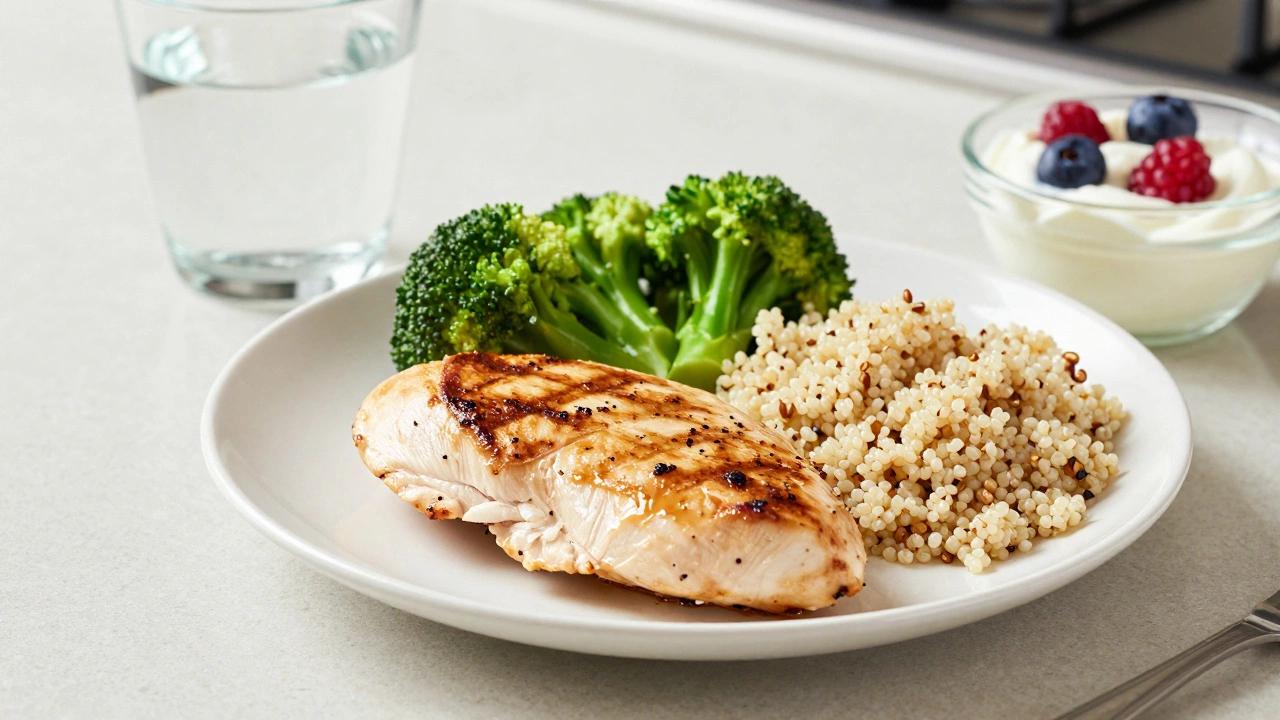
You can do every workout in the book, but if your diet is lacking, you will not see tone. Muscle is made of protein. If you do not provide your body with enough amino acids, it cannot repair the micro-tears caused by exercise. This repair process is what makes the muscle bigger and firmer.
Aim for approximately 1.6 to 2.2 grams of protein per kilogram of body weight daily. If you weigh 70kg (154 lbs), you should be eating between 112g and 154g of protein a day. Common sources include chicken breast, eggs, Greek yogurt, lentils, tofu, and whey protein powder.
Do not fear carbohydrates. Carbs fuel your high-intensity workouts. Without them, your performance drops, and you lift less weight, leading to less muscle stimulation. Focus on complex carbs like oats, sweet potatoes, and quinoa. Avoid liquid calories from sugary drinks, as these contribute to visceral fat storage around the organs, which pushes out the belly.
Sample Weekly Home Workout Plan
Consistency beats intensity. A moderate plan you stick to for six months will yield better results than an extreme plan you quit after two weeks. Here is a balanced 4-day split that targets all major muscle groups.
- Monday: Upper Body Strength
3 sets of Push-Ups (to failure)
3 sets of Dumbbell/TRX Rows (12 reps)
3 sets of Pike Push-Ups (for shoulders, 10 reps)
3 sets of Plank Hold (45-60 seconds) - Tuesday: Lower Body & Cardio
3 sets of Squats (15 reps)
3 sets of Reverse Lunges (12 reps per leg)
3 sets of Glute Bridges (20 reps)
15 minutes of Jump Rope or High Knees - Wednesday: Active Recovery
30-minute brisk walk or light yoga stretch session. - Thursday: Full Body Circuit
Perform as a circuit: 10 Burpees, 15 Squat Jumps, 10 Push-Ups, 30-second Mountain Climbers. Rest 90 seconds. Repeat 4 times. - Friday: Core & Stability
3 sets of Side Planks (30 seconds per side)
3 sets of Dead Bugs (12 reps per side)
3 sets of Bird-Dogs (12 reps per side)
3 sets of Hollow Body Holds (30 seconds) - Saturday/Sunday: Rest or Light Activity
Hiking, swimming, or complete rest.
Common Mistakes That Kill Progress
Many people fail to tone their bodies because they fall into specific traps. First, they do too much cardio. While cardio is great for heart health, excessive steady-state running can interfere with muscle growth by signaling the body to conserve energy rather than build tissue. Limit long-distance running if your primary goal is aesthetics.
Second, they neglect sleep. Muscle grows while you sleep, not while you work out. If you are getting less than seven hours of quality sleep, your cortisol levels rise. Cortisol promotes fat storage, particularly in the abdominal area, and breaks down muscle tissue. Prioritize your sleep hygiene as much as your workout form.
Third, they expect linear progress. Your body changes in waves. You might lose an inch off your waist one week and gain none the next. Trust the process. Take progress photos every two weeks under the same lighting conditions. The mirror lies; photos tell the truth.
FAQ
How long does it take to see toned muscles?
Most people begin to notice subtle changes in muscle firmness within 4 to 6 weeks of consistent strength training. Visible definition, where muscle striations become apparent, typically takes 3 to 6 months depending on your starting body fat percentage and adherence to nutrition goals.
Will lifting weights make me bulky?
No. Bulky muscles require a significant caloric surplus, years of dedicated heavy lifting, and often genetic predisposition. For most people, especially women, strength training leads to a leaner, tighter appearance rather than bulk. It increases metabolic rate, helping you burn more fat at rest.
Can I tone my body without going to the gym?
Absolutely. Bodyweight exercises like push-ups, squats, and lunges provide sufficient resistance for beginners and intermediates to build muscle. As you progress, you can increase difficulty by slowing down movements, adding reps, or using household items like water jugs as weights.
Is cardio necessary for toning?
Cardio is helpful for creating a caloric deficit to lose fat, but it is not strictly necessary for building muscle. Strength training is the primary driver of tone. However, adding 150 minutes of moderate cardio per week supports heart health and aids in fat loss without interfering significantly with muscle gains.
What is the best diet for toning?
The best diet for toning is one that is high in protein (1.6-2.2g per kg of body weight) and maintains a slight caloric deficit or maintenance level. Focus on whole foods like vegetables, lean meats, and complex carbohydrates. Avoid processed sugars and excessive alcohol, which hinder fat loss and muscle recovery.