

Belly Fat Loss Estimator
How Your Results Are Calculated
Based on scientific studies showing that 2-3 HIIT sessions weekly combined with healthy eating produces best results. Estimates include:
- 2.5 lbs of belly fat loss over 8 weeks with HIIT alone (per 2021 study)
- Up to 5 lbs with diet improvements (per 2023 study)
- Adjustments for sleep quality, stress, and session frequency
Estimated Belly Fat Loss
Based on your inputs and scientific research from the article
Realistic Expectations
Remember: Belly fat loss requires consistent effort over time. Even with perfect inputs, most people see 1-2% body fat reduction over 8-12 weeks (about 1-2 lbs for someone with 20% body fat).
Important Note
Overdoing HIIT can increase cortisol levels, which may counteract fat loss. Your results show that 2-3 sessions weekly is optimal for most people. Always listen to your body and prioritize recovery.
Ever stare at your reflection after a tough HIIT session and wonder if all that sweat is actually melting away belly fat? You’re not alone. Millions of people try HIIT because they’ve heard it’s the fastest way to lose fat-especially around the midsection. But does it really work? Or is it just another fitness myth wrapped in high-intensity bursts and Instagram hype?
The short answer: yes, HIIT can help reduce belly fat-but not because it’s magic. It works because of how it changes your body’s energy use, hormone balance, and recovery patterns. But there’s a catch. Doing 20 minutes of burpees every day won’t automatically give you a flat stomach if your diet is full of sugary snacks and processed meals. Let’s break down what science says, what really matters, and how to make HIIT work for your belly fat goals.
What Is HIIT, Really?
HIIT stands for High-Intensity Interval Training. It’s not just ‘working hard.’ It’s a specific pattern: short bursts of all-out effort (like sprinting or jumping jacks) followed by brief recovery periods (like walking or slow cycling). A typical session lasts 10 to 30 minutes. For example, you might do 30 seconds of mountain climbers, then 30 seconds of rest, repeated 8 times. That’s it.
Unlike steady-state cardio-like jogging for 45 minutes-HIIT doesn’t rely on long duration. It relies on intensity. During those max-effort intervals, your body burns through stored energy fast. Afterward, your metabolism stays turned up for hours. This is called EPOC-Excess Post-exercise Oxygen Consumption. Think of it as your body playing catch-up, burning extra calories even while you’re watching TV.
Studies from the University of New South Wales in 2017 showed that people doing HIIT three times a week lost more abdominal fat over 12 weeks than those doing moderate cardio five times a week-even though the HIIT group trained for less total time.
Why Belly Fat Is Different
Not all fat is the same. Belly fat, especially the deep kind called visceral fat, is more metabolically active than fat stored in your thighs or arms. Visceral fat wraps around your organs and releases inflammatory chemicals linked to insulin resistance, heart disease, and type 2 diabetes. Losing it matters for health, not just looks.
HIIT seems to target visceral fat better than steady cardio. A 2020 meta-analysis in the British Journal of Sports Medicine reviewed 39 studies and found that HIIT led to significantly greater reductions in visceral fat compared to moderate-intensity continuous training. Why? Because HIIT increases adrenaline and noradrenaline more sharply. These hormones signal fat cells-especially around the abdomen-to break down and release fatty acids into the bloodstream to be burned as fuel.
That’s the science. But here’s what no one tells you: you can’t spot-reduce fat. Doing a thousand crunches won’t burn fat just from your stomach. Fat loss happens system-wide. HIIT helps because it pushes your whole body to burn more fat overall-and your belly is often the first place your body pulls from when it needs energy.
How Much HIIT Do You Actually Need?
You don’t need to train like an Olympian. Research shows that even 12 minutes of HIIT, done three times a week, can lead to measurable fat loss. A 2021 study in the Journal of Obesity found that participants who did just 20 minutes of HIIT (four rounds of 30 seconds sprinting, 60 seconds walking) three times a week lost an average of 2.5 pounds of belly fat over eight weeks-without changing their diet.
But here’s the twist: results depend on consistency, not intensity alone. If you do one killer HIIT workout and then sit on the couch for the rest of the week, you won’t see much change. Aim for 2-3 sessions per week, with at least one rest day between them. Your body needs recovery to repair muscle and regulate stress hormones like cortisol.
Too much HIIT can backfire. Constant high stress raises cortisol, which can actually make your body hold onto belly fat. That’s why mixing HIIT with walking, yoga, or light strength training helps. Balance matters more than brute force.
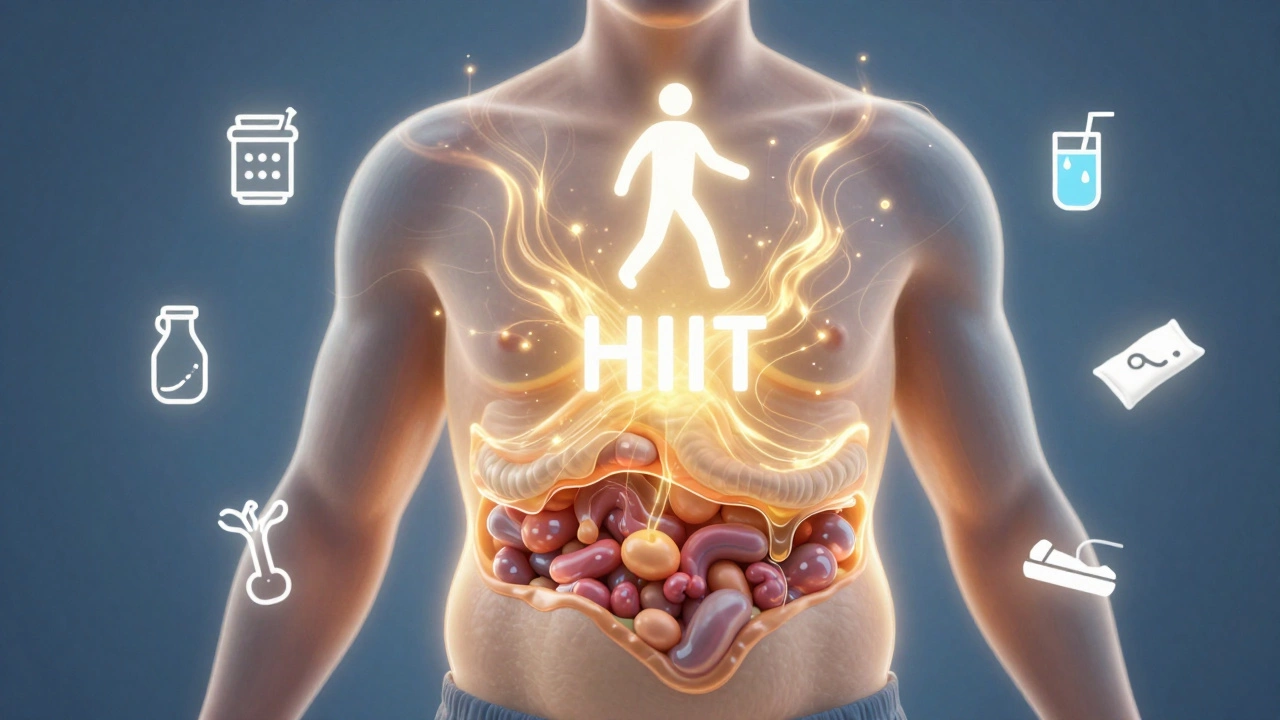
What You Can’t Ignore: Diet
HIIT is a powerful tool-but it’s not a magic eraser. You can’t out-exercise a bad diet. If you’re eating a lot of refined carbs, sugary drinks, or processed snacks, your body will keep storing fat, no matter how hard you sprint.
A 2023 study in the American Journal of Clinical Nutrition followed 80 adults doing HIIT three times a week. Half were given a simple nutrition guide: eat more protein, cut added sugar, and fill half your plate with vegetables. The other half got no dietary advice. After 12 weeks, the group that changed their eating habits lost nearly twice as much belly fat.
What works? Focus on:
- Protein: chicken, eggs, tofu, lentils-keeps you full and preserves muscle
- Fiber: oats, broccoli, apples, beans-slows digestion and stabilizes blood sugar
- Healthy fats: avocado, nuts, olive oil-helps regulate hormones
- Water: drink at least 2 liters a day-dehydration can mimic hunger
Avoid sugary coffee drinks, fruit juice, and ‘low-fat’ snacks loaded with sugar. They spike insulin, which tells your body to store fat-especially around your belly.
Realistic Results: What to Expect
Let’s get real. You won’t lose 10 pounds of belly fat in two weeks. That’s not how fat loss works. Most people see a 1-2% reduction in body fat over 8-12 weeks with consistent HIIT and better eating. For someone with 20% body fat, that’s about 1-2 pounds of fat lost from the midsection.
Don’t rely on the scale. Use a tape measure. Measure your waist at the narrowest point-right above your hip bones. A 1-inch reduction means you’re losing visceral fat, even if the number on the scale hasn’t budged. Muscle weighs more than fat. You might look leaner without losing weight.
Also, track how your clothes fit. If your jeans feel looser around the waist, that’s progress. Visual changes often show up before the scale moves.

Best HIIT Workouts for Belly Fat
You don’t need equipment. Here are three simple, effective routines you can do at home:
- Beginner HIIT (20 minutes): 30 seconds of high knees, 30 seconds rest. Repeat 8 times. Then 30 seconds of plank shoulder taps, 30 seconds rest. Repeat 6 times. Cool down with 5 minutes of walking.
- Intermediate HIIT (25 minutes): 40 seconds of burpees, 20 seconds rest. Repeat 6 times. Then 40 seconds of mountain climbers, 20 seconds rest. Repeat 6 times. Finish with a 1-minute wall sit and 5 minutes of stretching.
- Advanced HIIT (15 minutes): 45 seconds of jump squats, 15 seconds rest. Repeat 8 times. Then 45 seconds of kettlebell swings (or simulated swings with a water jug), 15 seconds rest. Repeat 6 times. Done.
Do each routine 2-3 times a week. Rest or walk on other days. Your body needs recovery to burn fat efficiently.
When HIIT Won’t Work
HIIT isn’t a cure-all. It won’t help if:
- You’re chronically stressed or sleeping less than 6 hours a night
- You’re drinking alcohol regularly-it blocks fat burning and increases visceral fat storage
- You have an undiagnosed thyroid issue or insulin resistance
- You’re doing HIIT every day without rest
If you’ve been consistent for 12 weeks and see no change, talk to a doctor. Hormonal imbalances, PCOS, or medication side effects can make belly fat stubborn. HIIT helps-but it can’t fix what your body can’t regulate on its own.
Final Takeaway
HIIT training can reduce belly fat-but only if you do it right. That means 2-3 sessions a week, proper recovery, and a diet focused on whole foods. It’s not about how hard you push in one session. It’s about consistency, patience, and smart habits over months.
Forget the quick fixes. The fat you want to lose took time to build. The results you want will take time to show. But if you stick with it, your waistline will shrink. Not because HIIT is a miracle. But because you finally gave your body the right signals to let go of what it no longer needs.
Can HIIT burn belly fat without diet changes?
HIIT can help burn some belly fat without changing your diet, but results are limited. Studies show that people who combine HIIT with better eating lose nearly twice as much visceral fat as those who only exercise. Food is the biggest factor in fat loss.
How often should I do HIIT to lose belly fat?
Two to three times per week is ideal. More than that can raise stress hormones like cortisol, which may cause your body to hold onto belly fat. Always pair HIIT with rest days or light activity like walking.
Is 10 minutes of HIIT enough to lose belly fat?
Yes, 10 minutes of true high-intensity intervals-where you’re pushing to 85-95% of your max effort-can be effective if done consistently. But you’ll need to combine it with a healthy diet and other movement throughout the day. Short workouts work best when they’re part of a larger healthy lifestyle.
Why am I not losing belly fat even though I do HIIT every day?
Doing HIIT daily can spike cortisol, which promotes fat storage around the abdomen. You’re likely overtraining and under-recovering. Try cutting back to 3 days a week, sleep 7-8 hours, reduce sugar and alcohol, and add walking on off days. Your body needs balance, not punishment.
Does HIIT work for women with PCOS and belly fat?
Yes, but with caution. Women with PCOS often have insulin resistance, which makes belly fat harder to lose. HIIT improves insulin sensitivity better than steady cardio, making it a good choice. But it should be combined with low-glycemic eating, stress management, and medical guidance. Avoid overtraining-it can worsen hormonal imbalance.
If you’ve tried HIIT and seen no change, don’t blame the workout. Look at your sleep, your stress, your plate. Fix those, and the fat will follow.