

Strength Training Nutrition & Progress Planner
Your Metrics
Enter your details to see your personalized nutrition targets and training focus.
Turning fifty feels like a threshold. For many, it’s the moment they realize their body doesn’t bounce back from a weekend hike or a late night quite like it used to. There’s a subtle shift-a stiffness in the morning, a slower recovery time, perhaps a nagging knee that whispers warnings before you even move. But here’s the truth that defies the aging narrative: your body is not breaking down; it’s just waiting for the right signal to stay strong. That signal is strength training.
If you’ve spent decades avoiding weights because you thought lifting was only for young bodybuilders or competitive athletes, this article is your permission slip. Strength training after 50 isn’t about looking like a magazine cover. It’s about independence. It’s about carrying groceries without strain, playing with grandchildren without exhaustion, and maintaining bone density that prevents fractures later in life. The science is clear: resistance exercise is the single most effective intervention against age-related muscle loss, known as sarcopenia, which begins悄然 around age 40 and accelerates after 60 if left unchecked.
Why Strength Training Matters More After 50
Let’s get one thing straight: cardio is great for your heart, but it won’t save your muscles. As we age, our bodies naturally lose muscle mass and strength. This isn’t just cosmetic; it’s functional. Muscle is metabolically active tissue-it burns calories even at rest. When you lose muscle, your metabolism slows, making weight management harder. Worse, weak muscles mean poor balance and higher fall risk. Falls are the leading cause of injury-related death in adults over 65. Strength training directly combats this by building the physical foundation for stability and resilience.
Beyond muscle, bones respond to load. Weight-bearing exercises stimulate osteoblasts-the cells responsible for bone formation. This is critical because osteoporosis affects nearly one in two women and one in four men over 50. Resistance training helps maintain bone mineral density, reducing fracture risk significantly. Think of it as depositing into your skeletal bank account while you still have time.
Then there’s the metabolic benefit. Insulin sensitivity declines with age, increasing the risk of type 2 diabetes. Strength training improves how your cells respond to insulin, helping regulate blood sugar levels. Studies show that just two sessions per week can improve glycemic control as effectively as some medications. And let’s not forget mental health: lifting weights releases endorphins and boosts confidence. Many people report better sleep, reduced anxiety, and a renewed sense of vitality after starting a consistent strength program.
Starting Smart: Safety First, Results Second
Before you pick up a dumbbell, take a breath. Starting strength training at 50 requires a different mindset than starting at 20. Your joints may have wear and tear. Your connective tissues aren’t as elastic. Your nervous system needs more time to adapt. That’s okay. In fact, it’s an advantage-you’re likely wiser about listening to your body.
The first step? Get cleared by a healthcare provider, especially if you have chronic conditions like hypertension, arthritis, or heart disease. Most doctors will encourage movement, but they may advise modifications. For example, if you have osteoarthritis in the knees, deep squats might aggravate pain, so chair squats or leg presses could be safer alternatives. If you have high blood pressure, avoid holding your breath during lifts (called the Valsalva maneuver), as it spikes pressure temporarily.
Next, find a qualified trainer who specializes in older adults or has experience working with clients over 50. Look for certifications like NSCA-CPT with geriatric specialization, ACE Senior Fitness Specialist, or NASM Corrective Exercise Specialist. A good trainer won’t push you to lift heavy too soon. They’ll teach proper form, progress gradually, and prioritize joint health over ego lifting.
If hiring a trainer isn’t feasible, start with bodyweight movements under video guidance from reputable sources like the American Council on Exercise (ACE) or National Institute on Aging (NIA). Free online resources exist, but beware of flashy “30-day shred” programs designed for 25-year-olds. Stick to slow, controlled movements with full range of motion.
Your First Workout: Simple, Safe, Sustainable
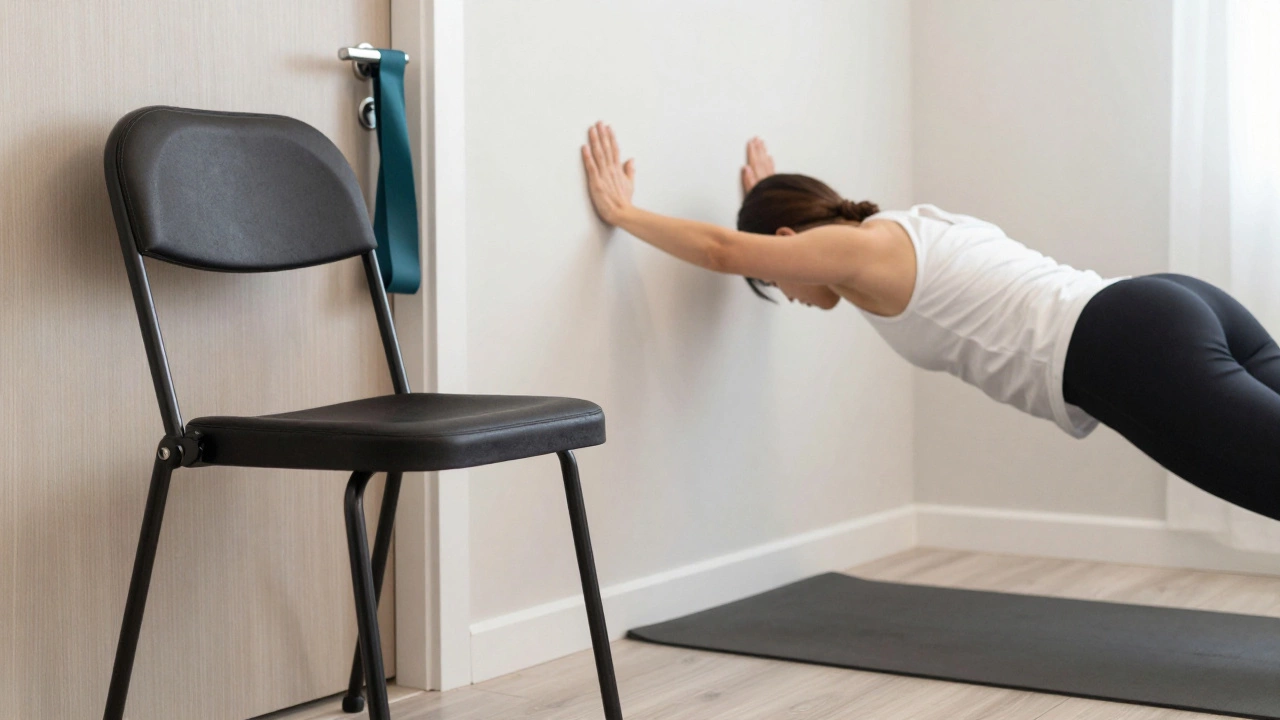
You don’t need a gym membership to begin. You don’t even need equipment. Here’s a beginner-friendly routine you can do at home, twice a week, with at least one day of rest between sessions. Focus on quality over quantity. Each rep should feel challenging but controlled-no jerking, no bouncing, no pain.
- Wall Push-Ups: Stand arm-length from a wall. Place hands shoulder-width apart. Lower chest toward wall, then push back. Do 2 sets of 10-12 reps. Builds upper body strength without stressing shoulders.
- Chair Squats: Sit down slowly onto a sturdy chair, then stand back up using your legs-not your arms. Keep chest up, knees behind toes. Aim for 2 sets of 8-10 reps. Strengthens quads, glutes, and core.
- Standing Calf Raises: Hold onto a counter for balance. Rise up on toes, hold for 2 seconds, lower slowly. 2 sets of 15 reps. Improves ankle stability and circulation.
- Resistance Band Rows: Anchor a band at waist height. Pull handles toward ribs, squeezing shoulder blades together. 2 sets of 10-12 reps. Counters slouching posture and strengthens back muscles.
- Glute Bridges: Lie on back, knees bent, feet flat. Lift hips until body forms straight line from shoulders to knees. Squeeze glutes at top. 2 sets of 12 reps. Activates posterior chain, supports lower back.
Rest 60-90 seconds between sets. Breathe out during exertion (pushing/pulling phase), breathe in during return. If any movement causes sharp pain, stop immediately. Discomfort is normal; pain is not.
Progressing Safely: How to Build Strength Over Time
Consistency beats intensity when you’re new. Don’t rush to add weight. Instead, focus on mastering form first. Once you can complete all reps with perfect technique, increase difficulty slightly. This principle is called progressive overload-and it’s the engine of strength gains.
Here’s how to progress intelligently:
- Weeks 1-4: Master bodyweight versions. Focus on mind-muscle connection. Feel each muscle working.
- Weeks 5-8: Add light resistance bands or water bottles (1-3 lbs). Increase reps to 12-15 per set.
- Weeks 9-12: Introduce dumbbells (5-10 lbs). Reduce reps to 8-10, increase rest to 90 seconds.
- Month 4+: Consider joining a gym class designed for seniors, such as SilverSneakers or Gold’s Gym Senior Circuit. These offer supervised, low-impact strength work tailored to mature bodies.
Track your progress in a notebook or app. Note weights used, reps completed, and how you felt afterward. Small improvements compound over months. Lifting 5 lbs now means you’ll handle 10 lbs next year-with less effort.
| Day | Activity | Focus |
|---|---|---|
| Monday | Strength Training (Full Body) | Movement patterns, form mastery |
| Tuesday | Walking or Swimming (30 min) | Cardiovascular health, mobility |
| Wednesday | Rest or Gentle Yoga | Recovery, flexibility |
| Thursday | Strength Training (Full Body) | Slight progression in load/reps |
| Friday | Balance & Core Work (15 min) | Stability, fall prevention |
| Saturday | Active Leisure (Gardening, Hiking) | Functional movement, enjoyment |
| Sunday | Complete Rest | Muscle repair, mental refresh |

Nutrition: Fueling Muscle Growth After 50
You can’t out-train a bad diet-especially after 50. Protein needs increase with age because older bodies become less efficient at synthesizing muscle protein. While younger adults need about 0.8 grams of protein per kilogram of body weight, research suggests those over 50 benefit from 1.2-1.6 grams/kg daily to support muscle maintenance and growth.
That translates to roughly 70-100 grams of protein per day for an average-sized person. Spread it across meals: aim for 20-30 grams per sitting. Good sources include eggs, Greek yogurt, lentils, chicken breast, tofu, and whey isolate powder (if tolerated).
Don’t neglect hydration. Dehydration mimics fatigue and reduces performance. Drink water consistently throughout the day-not just during workouts. Limit alcohol, which interferes with muscle recovery and disrupts sleep architecture.
Vitamin D and calcium are crucial partners in strength training. Vitamin D aids muscle function and immune response; deficiency is common in older adults due to reduced sun exposure and skin synthesis efficiency. Consider getting your levels checked and supplementing if below 30 ng/mL. Calcium supports bone integrity-but get it from food (dairy, leafy greens, fortified plant milks) rather than megadoses, which may pose cardiovascular risks.
Mindset Shifts: Embracing Strength as Self-Care
One of the biggest barriers isn’t physical-it’s psychological. Many people over 50 believe they’re “too old” to change their physique or capabilities. Or they fear injury. Or they think strength training equals bulkiness. None of these beliefs hold up under scrutiny.
First, you cannot accidentally become bulky. Building significant muscle mass requires years of dedicated training, precise nutrition, and often genetic predisposition. What you *will* achieve is tone, definition, and functional power. Second, injury risk drops dramatically when you train smart. Proper warm-ups, gradual progression, and attentive coaching minimize harm far more than staying sedentary does.
Think of strength training as preventive medicine. Just as you brush your teeth daily to prevent cavities, you lift weights regularly to prevent frailty. It’s not punishment; it’s preservation. Every session is an investment in future freedom-to travel, to garden, to dance, to live fully without limitations imposed by weakness.
Start small. Celebrate tiny wins. Did you stand up from a chair without using your hands today? That’s victory. Could you carry your shopping bag further without shoulder ache? Progress. Strength isn’t measured in pounds lifted alone-it’s measured in life lived well.
Is it safe to start strength training at 50 if I’ve never exercised before?
Yes, absolutely. In fact, it’s one of the best things you can do for long-term health. Begin with bodyweight exercises and consult your doctor first if you have existing medical conditions. Progress slowly, prioritize form, and consider working with a certified trainer initially to ensure safety.
How much protein do I really need after 50?
Aim for 1.2-1.6 grams of protein per kilogram of body weight daily. For a 70kg person, that’s 84-112 grams. Distribute evenly across meals-about 25-30g per meal-for optimal muscle protein synthesis. Include lean meats, dairy, legumes, and nuts.
Can I build muscle at 50+?
Absolutely. While muscle gain happens slower than in youth, studies confirm significant hypertrophy is possible with consistent resistance training and adequate protein intake. Many individuals see noticeable changes within 8-12 weeks.
What if I have joint pain or arthritis?
Modify exercises to reduce stress on affected joints. Use seated or supported positions, substitute machines for free weights, and avoid deep ranges of motion if painful. Water-based resistance training is excellent for arthritic joints. Always communicate discomfort to your trainer or physician.
Do I need to join a gym?
Not necessarily. Home workouts with resistance bands, dumbbells, or bodyweight suffice for beginners. Gyms offer variety and supervision, but consistency matters more than location. Start where you feel comfortable and confident.