

5x5 Strength Progression Calculator
Input Your Current Stats
Your Starting Weights
Enter your stats and click generate to see your recommended starting weights for safe 5x5 training.
Projected Strength Progression
Imagine walking into a gym and seeing someone load up their bar with heavy plates. They don’t rush. They don’t do fancy jumps or complicated circuits. They simply lift the weight five times, rest, and repeat that process for four more sets. It looks almost boring. Yet, this simple routine has built some of the strongest athletes on the planet. This is the essence of the 5x5 rule in lifting.
If you are tired of confusing workout charts and endless cardio machines, this method might be exactly what you need. But before you grab a barbell, you need to understand why it works, how to structure your sessions, and where beginners often make costly mistakes.
The Core Concept Behind 5x5 Training
The 5x5 rule is a strength training protocol where you perform five sets of five repetitions for each exercise. The goal isn't just to move weight; it's to build raw power and muscle density through consistency and gradual increases in load.
Why five reps? In the world of resistance training, rep ranges dictate physiological adaptations. Low reps (1-3) focus purely on neural efficiency and maximum strength. High reps (12-15+) target muscular endurance and metabolic stress. The middle ground, specifically 5 reps, hits the sweet spot for hypertrophy (muscle growth) while simultaneously teaching your nervous system to recruit more muscle fibers efficiently.
By doing five sets, you accumulate enough volume to stimulate growth without causing excessive fatigue that would compromise your form. It’s a balance. You get enough work done to signal your body to adapt, but not so much that you burn out after two weeks.
Who Should Use the 5x5 Method?
This approach is not one-size-fits-all, but it is exceptionally effective for specific groups. If you fall into any of these categories, 5x5 is likely a great fit:
- Absolute Beginners: If you have never lifted weights, your body will respond dramatically to almost any stimulus. 5x5 teaches proper technique under moderate loads before you ever attempt maximal lifts.
- Intermediate Lifters Plateauing: If you have been doing random workouts for years but haven't seen strength gains, the structured progression of 5x5 forces you to track numbers and improve systematically.
- Time-Crunched Individuals: A full 5x5 session typically takes 45 to 60 minutes. You hit every major muscle group in three days a week. There is no need for hour-long cardio add-ons if your primary goal is building a solid physical foundation.
However, advanced bodybuilders aiming for peak aesthetics might find the volume insufficient for isolating small muscles like biceps or calves. Powerlifters competing at elite levels may need more specialized programming around their competition lifts. For everyone else, though, it remains a gold standard.
Choosing Your Exercises: The Big Three
The effectiveness of 5x5 relies heavily on compound movements. These are exercises that engage multiple joints and muscle groups simultaneously. You cannot effectively do a 5x5 routine using only dumbbell curls or leg extensions. You need lifts that allow you to move significant weight safely.
Most successful 5x5 programs revolve around variations of three core lifts:
- Squat: Targets quads, hamstrings, glutes, and lower back. It builds lower body power and core stability.
- Bench Press: Works the chest, shoulders, and triceps. It develops upper body pushing strength.
- Deadlift or Overhead Press: Deadlifts target the posterior chain (back, hamstrings, glutes), while overhead presses build shoulder strength and upper back stability. Most programs alternate between these two depending on the day.
Some popular programs, like StrongLifts 5x5 or Starting Strength, include a fifth exercise such as Barbell Rows or Pull-Ups to ensure balanced development. Without pulling movements, you risk developing rounded shoulders and poor posture from all the pressing.
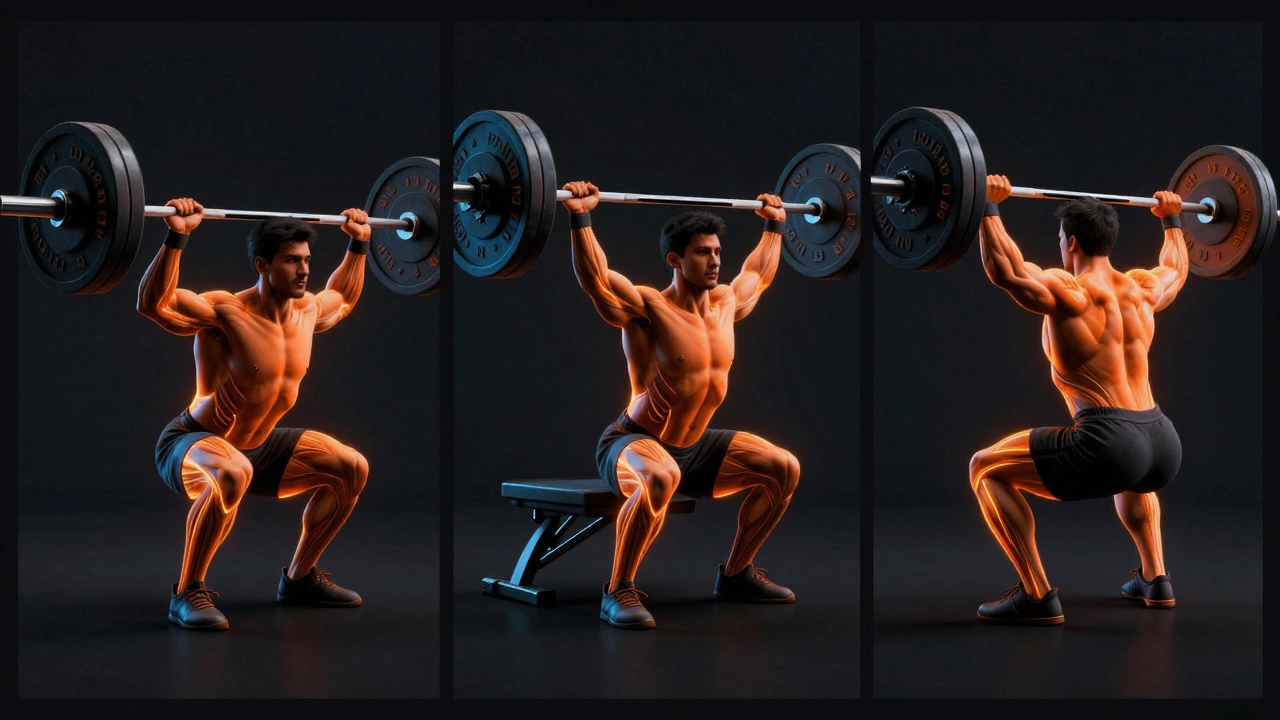
How to Structure Your Weekly Schedule
Consistency beats intensity in the long run. You cannot train 5x5 every day because your central nervous system needs time to recover. The most common split is an A/B rotation performed three times a week.
| Day | Workout Type | Exercises |
|---|---|---|
| Monday | Workout A | Squat, Bench Press, Barbell Row |
| Tuesday | Rest | Light walking or stretching |
| Wednesday | Workout B | Squat, Overhead Press, Deadlift |
| Thursday | Rest | Active recovery |
| Friday | Workout A | Squat, Bench Press, Barbell Row |
| Saturday/Sunday | Rest | Full rest |
Notice that Squats appear in both Workout A and Workout B. This frequency ensures you practice the movement pattern often enough to master it. As you progress, you might switch to a Full Body Every Other Day schedule to manage fatigue better.
Progressive Overload: The Engine of Growth
You can do 5x5 forever, but if you use the same weight, you will stop getting stronger. This is where progressive overload comes in. The rule is simple: if you complete all five sets of five reps with good form, you increase the weight by the smallest increment possible next session.
In most gyms, the smallest plate is 2.5 kg (5 lbs). So, if you bench pressed 60 kg for 5x5 on Monday, you aim for 62.5 kg on Wednesday. If you succeed, you go to 65 kg on Friday. This linear progression is incredibly motivating. You see tangible proof of your improvement every single workout.
However, life happens. Maybe you slept poorly, had a stressful week, or ate less protein than usual. Sometimes, you will fail to hit five reps on the fifth set. That is normal. Do not panic. Do not double the weight next time. Instead, drop the weight by 10% for the next session, rebuild confidence, and try again. Consistency over months matters more than perfection in a single week.

Common Mistakes to Avoid
Even simple routines have pitfalls. Here is what derails most people starting 5x5:
- Ego Lifting: Adding too much weight too soon compromises form. A squat with a rounded back is not a squat; it is a recipe for a herniated disc. Prioritize technique over weight.
- Neglecting Warm-ups: Jumping straight into heavy sets cold is dangerous. Spend 5-10 minutes doing dynamic stretches and lighter warm-up sets before your working sets.
- Ignoring Accessory Work: While 5x5 builds base strength, adding 2-3 sets of isolation exercises (like bicep curls or lateral raises) at the end of your workout can help fix imbalances and prevent injury.
- Poor Nutrition: You cannot build muscle out of thin air. Ensure you are eating enough protein (roughly 1.6 to 2.2 grams per kilogram of body weight) and maintaining a slight caloric surplus if your goal is size.
When to Move On From 5x5
No program lasts forever. Eventually, you will reach a point where adding 2.5 kg becomes impossible. For most natural lifters, this plateau occurs after 6 to 12 months of consistent training. When this happens, it doesn't mean you have failed. It means you have graduated from beginner status.
At this stage, you might consider switching to a periodized program that varies rep ranges (e.g., 3x8, 5x5, 3x3) or focuses on weaker points in your lifts. You might also split your training into upper/lower days to allow for more recovery per muscle group. But until you hit that wall, stick with 5x5. It is one of the most efficient ways to transform your physique and strength.
Can I do 5x5 for muscle building (hypertrophy)?
Yes. While 5x5 is primarily a strength program, the mechanical tension created by heavy compound lifts stimulates significant muscle growth. For many beginners, 5x5 is actually superior to high-rep bodybuilding routines because it builds a dense, strong foundation. Just ensure you are eating enough calories to support muscle gain.
How long should I rest between sets?
For heavy compound lifts like squats and deadlifts, rest for 2 to 3 minutes. This allows your ATP-PC energy system to replenish fully, ensuring you can lift the same weight for all five sets. For smaller accessory movements, 60 to 90 seconds is usually sufficient.
Is 5x5 safe for older adults?
It can be, provided the individual is cleared by a doctor and starts with very light weights. Strength training is crucial for bone density and independence in aging. However, modifications like box squats or machine-based alternatives may be safer initially than free-weight barbell lifts.
What if I miss a workout?
Don't worry about it. Just resume your schedule the next planned day. Do not try to "make up" the missed workout by doing extra volume, as this leads to overtraining. Consistency over months is far more important than perfection in a single week.
Do I need a gym membership for 5x5?
Ideally, yes. Standard 5x5 requires a barbell, rack, and plates. While you can simulate some movements with kettlebells or dumbbells at home, the ability to progressively overload with small increments is much harder without a full barbell setup. Home gyms with adjustable racks are a viable alternative if you have the space and budget.