

Personalized Step Goal Calculator
You’ve probably heard the magic number: 10,000 steps. It’s plastered on wristbands, shouted by influencers, and set as the default target in almost every fitness app is software designed to track physical activity, nutrition, and health metrics. But here is the uncomfortable truth that most people ignore: 10,000 steps is not a scientifically proven requirement for weight loss. It is a marketing gimmick from a Japanese pedometer company in the 1965 Olympics.
If you are trying to drop pounds, counting steps is useful, but only if you understand the math behind them. You don’t need to hit a specific arbitrary number to see results. You need to create a calorie deficit. Steps are just one way to burn those calories. So, how many steps do you actually need? The answer depends entirely on your current activity level, your diet, and how fast you want to move.
The Myth of the 10,000 Step Goal
Let’s clear the air first. Where did this obsession come from? In 1965, a Japanese company called Yamasa Clock & Instrument Co. launched a pedometer called "Manpo-Kei," which translates to "10,000 steps meter." They chose the number because it sounded catchy and ambitious, not because a scientist said it was the threshold for health.
Decades later, we still treat it like gospel. But modern research tells a different story. A landmark study published in JAMA Internal Medicine followed over 16,000 women and found that mortality risk decreased with each additional 1,000 steps per day, up to about 7,500 steps. After that, the benefits plateaued. This doesn't mean 7,500 is the magic number for *weight loss*, but it does prove that more isn't always linearly better after a certain point.
For weight loss specifically, the goal isn't just "health"-it's energy expenditure. If you walk 10,000 steps but eat back all the calories you burned, you won't lose an ounce. The step count is secondary to the energy balance equation.
The Real Formula: Steps + Calorie Deficit
To lose weight, you must burn more calories than you consume. This is non-negotiable. Walking helps you burn calories, but it also increases your appetite for some people. Here is how to calculate your personal step goal using data rather than guesswork.
First, estimate your Total Daily Energy Expenditure (TDEE). This is the number of calories your body burns in a day doing nothing extra. Let’s say your TDEE is 2,000 calories. To lose one pound of fat, you need a deficit of roughly 3,500 calories. That means you need a daily deficit of 500 calories to lose one pound per week.
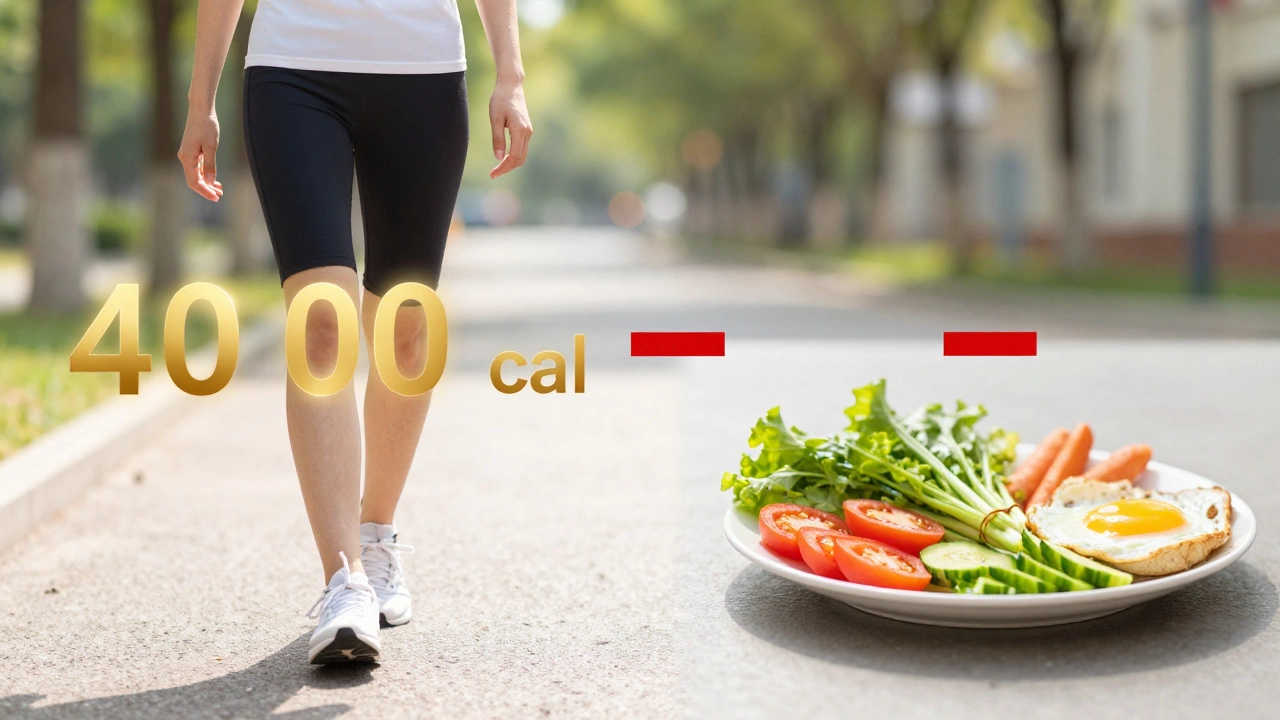
Now, let’s look at walking. On average, a person burns about 0.04 calories per step. This varies based on weight, speed, and terrain, but it’s a solid baseline.
- 1,000 steps ≈ 40 calories burned
- 5,000 steps ≈ 200 calories burned
- 10,000 steps ≈ 400 calories burned
If you need a 500-calorie deficit, walking alone would require about 12,500 steps per day. That’s tough for most people. Most successful dieters combine moderate walking with slight dietary adjustments. For example, cutting 250 calories from food and burning 250 calories through walking (about 6,000 extra steps) achieves the same result with less fatigue.
Personalizing Your Step Count
There is no single number that works for everyone. Your starting point matters immensely. If you currently sit at a desk all day and take 3,000 steps, jumping to 10,000 will lead to injury or burnout. Instead, use the "10% Rule": increase your weekly step total by no more than 10% compared to the previous week.
| Current Activity Level | Initial Goal | Maintenance Goal | Weight Loss Accelerator |
|---|---|---|---|
| Sedentary (< 4,000 steps) | 5,000 steps | 7,000 steps | 8,500+ steps |
| Lightly Active (4,000-7,000 steps) | 7,500 steps | 9,000 steps | 10,000+ steps |
| Active (> 7,000 steps) | 10,000 steps | 12,000 steps | 14,000+ steps |
Notice that even for active people, the jump from maintenance to acceleration is significant. If you are new to movement, focus on consistency over intensity. Walking 5,000 steps every day for a month is far more effective for long-term weight loss than sprinting to 10,000 steps for three days and then quitting.
Why Speed Matters More Than Distance
Not all steps are created equal. Strolling slowly to the fridge burns fewer calories than brisk walking to the store. To maximize fat loss, you need to elevate your heart rate. Aim for a pace where you can talk but not sing. This is often called "Zone 2" cardio.
Brisk walking increases your post-exercise oxygen consumption (EPOC), meaning your body continues to burn calories at a slightly higher rate even after you stop moving. While the effect is modest compared to high-intensity interval training (HIIT), it adds up over weeks. If you have limited time, try breaking your steps into three 10-minute bursts throughout the day rather than one long hour-long walk. Research suggests this approach improves insulin sensitivity and keeps metabolism active during work hours.
Using Fitness Apps to Track Progress
This is where technology becomes your ally. Relying on memory is unreliable. You think you walked 10,000 steps, but your phone says 6,500. Using a dedicated step counter app or a wearable device ensures accuracy.
Most popular fitness apps offer more than just step counting. They integrate with GPS to measure distance and elevation, which helps calculate a more accurate calorie burn. Some apps even analyze your stride length to refine these numbers. When choosing an app, look for one that syncs seamlessly with your phone’s health data. This allows you to see the big picture: steps, sleep, and nutrition all in one place.
However, beware of "gaming" the system. Shaking your arm to inflate step counts won’t help you lose weight. The app is only as good as the data you feed it. Wear your device consistently, preferably on your dominant wrist, and calibrate it if possible. Accuracy builds trust in the process.

The Role of NEAT in Weight Loss
Steps are part of a broader concept called Non-Exercise Activity Thermogenesis (NEAT). This includes everything from fidgeting to gardening to taking the stairs. Studies show that NEAT can account for up to 500 calories burned per day in highly active individuals. By focusing on steps, you are essentially targeting your largest controllable source of NEAT.
Increase your NEAT intentionally. Park further away at the supermarket. Take calls while standing or pacing. Use a standing desk. These small actions add thousands of steps without feeling like a workout. Over a year, this difference can amount to several pounds of fat loss without ever stepping foot in a gym.
Pitfalls to Avoid
Even with the right step count, you can sabotage your progress. Here are common mistakes:
- Eating Back Calories: Thinking you earned a large meal because you hit your step goal. Remember, 10,000 steps might only be 400 calories. A single pastry can undo that effort.
- Ignoring Strength Training: Walking is great for cardio, but it doesn’t build muscle. Muscle tissue burns more calories at rest than fat tissue. Incorporate two days of resistance training per week to keep your metabolism high.
- Overestimating Burn: Apps often overestimate calorie burn by 10-20%. Use their numbers as a guide, not gospel. Focus on trends over time rather than daily fluctuations.
- Burnout: Setting unrealistic goals leads to quitting. Start small. Consistency beats intensity every time.
Creating a Sustainable Routine
Weight loss is a marathon, not a sprint. Your step goal should evolve as you get fitter. Once 7,000 steps feels easy, bump it to 8,000. Listen to your body. If you feel exhausted, take a rest day. Sleep is crucial for weight loss; poor sleep increases hunger hormones and decreases motivation to move.
Combine your walking strategy with mindful eating. You don’t need a restrictive diet. Just aim for whole foods, adequate protein, and portion control. Protein helps preserve muscle mass while you lose fat, ensuring your steps translate to leaner body composition rather than just lower scale numbers.
Finally, track your progress beyond the scale. Take measurements, notice how your clothes fit, and monitor your energy levels. Sometimes the scale stalls while your body recomposes itself. Trust the process. Keep walking, stay consistent, and the weight will follow.
Is 10,000 steps a day necessary to lose weight?
No, 10,000 steps is not a scientific requirement for weight loss. It is a marketing target. Research shows that significant health benefits occur between 7,000 and 8,000 steps. For weight loss, what matters more is creating a calorie deficit. If you burn more calories than you consume, you will lose weight, regardless of whether you hit exactly 10,000 steps. However, aiming for 7,000-10,000 steps is a practical way to ensure you are active enough to support a deficit.
How many calories do I burn per 1,000 steps?
On average, a person burns approximately 0.04 calories per step, meaning 1,000 steps burn about 40 calories. However, this varies significantly based on your body weight, walking speed, and terrain. Heavier individuals burn more calories per step than lighter ones. Brisk walking also burns more calories than slow strolling. Use this as a rough estimate, but rely on your overall weekly trend rather than precise daily calculations.
Can I lose weight by walking alone without changing my diet?
It is possible but very difficult. Walking burns calories, but it is easy to offset that burn with food. For example, a 30-minute walk might burn 150 calories, which is equivalent to a few bites of pizza or a small snack. Most people find it easier to manage weight by combining moderate walking with slight dietary adjustments. Focusing solely on exercise often leads to increased hunger, which can hinder progress.
Does the speed of my walk matter for weight loss?
Yes, speed matters. Brisk walking elevates your heart rate and increases calorie burn per minute compared to slow walking. It also triggers a slight afterburn effect (EPOC), where your body continues to burn calories after the activity ends. Aim for a pace where you can talk but not sing. This intensity maximizes fat oxidation and improves cardiovascular health more effectively than leisurely strolling.
What is the best time of day to walk for weight loss?
The best time to walk is whenever you can do it consistently. Some studies suggest morning walks may boost metabolism for the rest of the day, while others argue evening walks help regulate blood sugar after dinner. Ultimately, adherence is key. If you prefer walking before work, do that. If you prefer after dinner, do that. Breaking walks into smaller chunks throughout the day can also be effective for maintaining energy levels and increasing NEAT.
How do fitness apps help with step tracking?
Fitness apps provide accurate tracking, historical data, and motivational tools. They sync with your phone’s sensors or wearable devices to count steps, measure distance, and estimate calories burned. Many apps also offer social features, challenges, and integration with nutrition trackers. This holistic view helps you understand the relationship between movement, food intake, and weight change, making it easier to adjust your habits for better results.